Wednesday, September 16, 2026
How many words does each hiring step actually give you?
Every hiring process is a series of attempts to answer one question: can this person do the job? Each step gives you a little more information to answer it with. What most teams never do is measure how much.
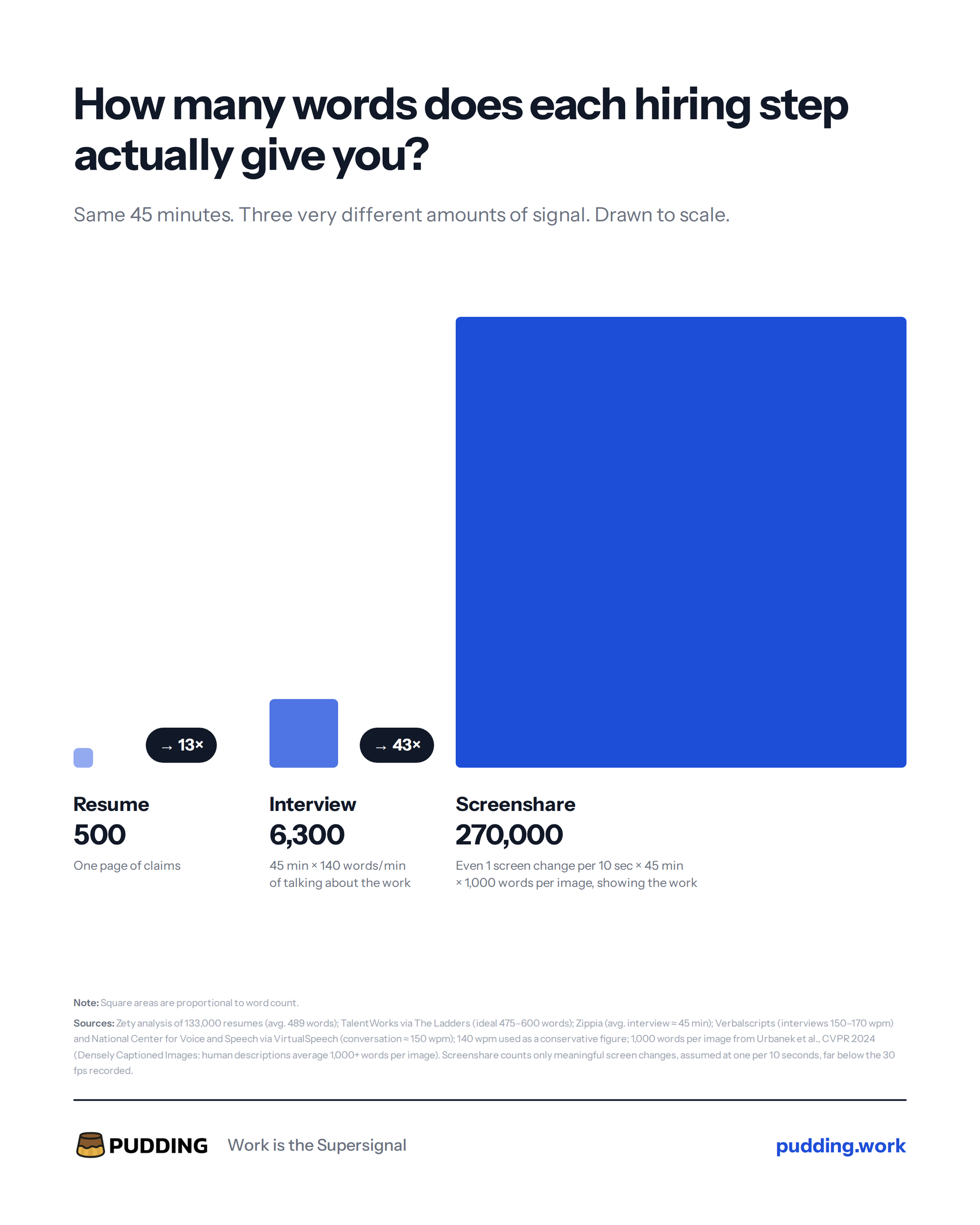
We did. The short version: a resume gives you about 500 words. A 45-minute interview gives you about 6,300. A 45-minute screenshare in which the candidate opens up their real work and walks you through it gives you, at a minimum, 270,000. The numbers are rough, and we chose them to understate the case rather than overstate it. Even so, the last step is not a little better than the first two. It is a different category of evidence.
The resume: 500 words
An analysis of 133,000 resumes by Zety puts the average at 489 words. Separate research from TalentWorks, covering more than 6,000 applications, found that resumes between 475 and 600 words performed best. So 500 is a fair number for a typical, well-made resume.
Those 500 words are also the most carefully curated words a candidate will ever produce. They are written by the person being evaluated, revised over weeks, often reviewed by friends or paid editors, and shaped to match the job description. That is not a criticism. It is simply what a resume is: a summary of claims, presented in the best possible light.
The interview: about 6,300 words
The average interview runs about 45 minutes, according to Zippia's hiring research. Conversational speech in English runs around 150 words per minute according to the National Center for Voice and Speech, and transcription firms that handle interviews report 150 to 170. We used 140 to leave room for pauses and thinking. That gives you roughly 6,300 words.
It is worth being honest about what those words contain. Roughly half of them are the interviewer's. And the candidate's half is a description of the work, from memory, delivered under pressure, by someone who has usually rehearsed. An interview is a big improvement on a resume. It is still a conversation about the work, with nothing on the table to check it against.
The screenshare: at least 270,000 words
This is where the arithmetic gets interesting, and where we were most careful.
First, what we mean by a screenshare. Not a live coding test, and not surveillance. The candidate shares their screen and walks through something they have actually built or delivered: the finished product, the files behind it, the version history, the dashboards, the tools they used and the traces those tools leave. They explain what they did and why, and they answer questions as they go. It is the same conversation as an interview, except the work is on screen the whole time.
The phrase "a picture is worth a thousand words" started as advertising copy in 1921. It turns out to be roughly accurate. In 2024, researchers at Meta asked people to write complete descriptions of ordinary photographs. Across nearly 8,000 images, those descriptions averaged more than 1,000 words each. A screen showing a codebase, a financial model, a design file, or a project's commit history contains at least as much describable detail as a photograph. So 1,000 words per screen is a reasonable figure.
The harder question is how many screens. A recording captures 30 frames per second, but most of those frames are nearly identical to the one before. Counting all of them would be dishonest. So we counted only meaningful changes, the moments where what is on screen is different enough to tell you something new, and assumed one every ten seconds.
Anyone who has watched someone give a walkthrough of their own work knows that is a low estimate. They open files, scroll through history, switch between the product and the code behind it, pull up the result. The screen changes constantly. One change every ten seconds is well under the real rate.
Forty-five minutes at one change every ten seconds is 270 screens. At 1,000 words each, that is 270,000 words, and that is before you count anything said out loud along the way. Forty-three times the interview. Five hundred and forty times the resume.
We chose every input so that a reasonable person who disagrees with it would move the number up, not down.
What "more words" actually means
Words are a proxy. What they stand in for is how much of the truth you get to see.
A resume shows you what a candidate chose to say about themselves. An interview shows you how they describe their work when asked. A screenshare shows you the work itself, with the candidate's explanation attached to it. You see whether the finished thing matches the description. You see the history: how many revisions, how the approach changed, what was there before the polish. You see which tools they reach for and how comfortably. And you hear them explain decisions while pointing at the evidence for them, which is very hard to fake and very easy to check.
None of that survives translation into a resume bullet. Most of it does not survive an interview answer either. A candidate can say "I led the migration." On a screenshare, they can open the migration.
Why this doesn't happen already
Most hiring managers would love to see the last six or eight candidates walk through their real work. Almost none do it, and the reason is not the information. It is that doing it live does not scale.
A live screenshare means finding a slot in two calendars for every semifinalist. It means the hiring manager asking the same opening questions eight times, in eight separate meetings, and trying to hold eight different walkthroughs in their head well enough to compare them. It means sitting through the whole session every time, because there is no way to skip ahead or go back in a live call. And it means the candidate performing for an audience rather than showing their work the way they would to a colleague. The information is there. The format makes it too expensive to collect.
Pudding takes the live meeting out of it. The candidate records the session on their own time with an AI interviewer that watches the screen as they share it and asks its questions based on what it sees. When the candidate opens a file, the interviewer can ask about that file. When they skip past something, it can ask them to go back. The questions follow the work, the way a sharp interviewer's would, without a second calendar to book. And because the interviewer is asking about what it can see, the questions cannot be prepared for. Show a background job and it may ask how you chose the concurrency. Show a dashboard and it may ask what the number was before you fixed it. You can rehearse a story about your work. You cannot rehearse follow-ups to a screen the questioner is looking at.
Candidates are paid for the session. Pudding pays them on behalf of the hiring company. It is real work on their part, and it is treated that way.
The hiring manager gets the recording, a transcript, timestamps for each part of the session, and a summary of what was shown. Where the candidate demonstrated something concrete, such as a document, an image, or a folder of files, that comes through as well, so the evidence is not just on screen but in hand. Pudding does not score, rank, or judge. It records, transcribes, and summarizes. The judgement stays with the person whose job it is to make it.
Here is what the arithmetic above means in practice for the person watching. An interview delivers about 140 words a minute. A screenshare delivers about 6,000 words a minute, on the conservative count. That is nearly a whole interview's worth of information every sixty seconds. So the hiring manager does not need to watch the full 45 minutes to reach a view. Signal surfaces fast. A few minutes in, it is usually clear whether the work is real, whether it matches the resume, and whether the person can explain it. From there they can scrub to the parts that matter for the role, skip the rest, and go back to compare one candidate's answer directly against another's.
The result is that the person making the decision sees the evidence directly, for every candidate, in a fraction of the time a single live round would have taken. The summary tells them where to look. The recording lets them see it for themselves.
Our sources
- Resume length: Zety's analysis of 133,000 resumes (average 489 words); TalentWorks research via The Ladders (best-performing range 475–600 words).
- Interview length: Zippia's job interview statistics (average about 45 minutes).
- Speaking rate: National Center for Voice and Speech via VirtualSpeech (about 150 words per minute in conversation); Verbalscripts (150–170 words per minute in one-on-one interviews). We used 140.
- Words per image: Urbanek et al., A Picture is Worth More Than 77 Text Tokens, CVPR 2024. Human descriptions in the Densely Captioned Images dataset average more than 1,000 words per image.
- Screen changes: assumed at one every ten seconds. Pudding records at 30 frames per second; the assumption is deliberately far below that.
If you think any of these numbers are wrong, we would like to hear it. Just be aware that most of the corrections we can imagine make the gap larger.
Pudding runs asynchronous AI interviews over screenshare, where semifinalists and finalists show their real work and hiring managers watch it. Work is the Supersignal. [pudding.work](https://pudding.work)